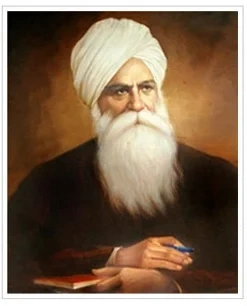
Bhai Vir Singh
Bhai Vir Singh, widely recognized as the "Father of Modern Punjabi Literature," was born into a highly intellectual Amritsar family. His father, Dr. Charan Singh, was a prominent medical practitioner and multi-lingual scholar of Brij Bhasha, Hindi, a...
1872
1957
Amritsar, Punjab
Biography
Bhai Vir Singh, widely recognized as the "Father of Modern Punjabi Literature," was born into a highly intellectual Amritsar family. His father, Dr. Charan Singh, was a prominent medical practitioner and multi-lingual scholar of Brij Bhasha, Hindi, and Sanskrit, while his maternal grandfather, Giani Hazara Singh, was a respected scholar who translated classical Persian texts. This rich academic environment deeply shaped Vir Singh’s early life, enabling him to graduate first in his district from the Church Mission School in 1891, winning a gold medal.
Instead of pursuing lucrative government positions under the colonial administration, Vir Singh chose to revitalize his native language and culture through the power of print capitalism. In 1892, he co-founded the Wazir-e-Hind Printing Press, followed shortly by the establishment of the Khalsa Tract Society in 1894. His primary aim was to distribute accessible, high-quality literature promoting Punjabi language, culture, and reformist Sikh values during a period dominated by Christian missionary proselytization and colonial cultural shift.
Bhai Vir Singh was a highly prolific writer who pioneered multiple literary genres in Punjabi. His novel Sundri (1898), which depicts the resilience of a brave Sikh woman named Surasti who escapes a Mughal official's harem to join a Sikh Jatha, is celebrated as the first modern novel in the Punjabi language. His epic work Rana Surat Singh (1905) introduced a blank verse format to depict the spiritual journey of Rani Raj Kaur following the death of her husband, pioneering the use of verse for high philosophical introspection. He also annotated historical texts, publishing the Puratan Janam Sakhi Guru Nanak Dev and the Gurbani dictionary Punj Granthi in 1906.
Beyond literature, he was a pivotal social reformer, co-founding Khalsa College (1902), the Chief Khalsa Diwan (1901), the Punjab & Sind Bank (1908), and the Central Sikh Orphanage. In recognition of his massive contributions, he was awarded an honorary Doctorate of Literature by Panjab University in 1949, won the Sahitya Akademi Award in 1953 for Mere Saiyan Jeo, and was honored with the Padma Bhushan in 1956.
At a Glance
- Works Archived
- 0 volumes
Published Works
No published works have been archived for this writer yet.